
You don't have a neck problem. You have a pillow problem.
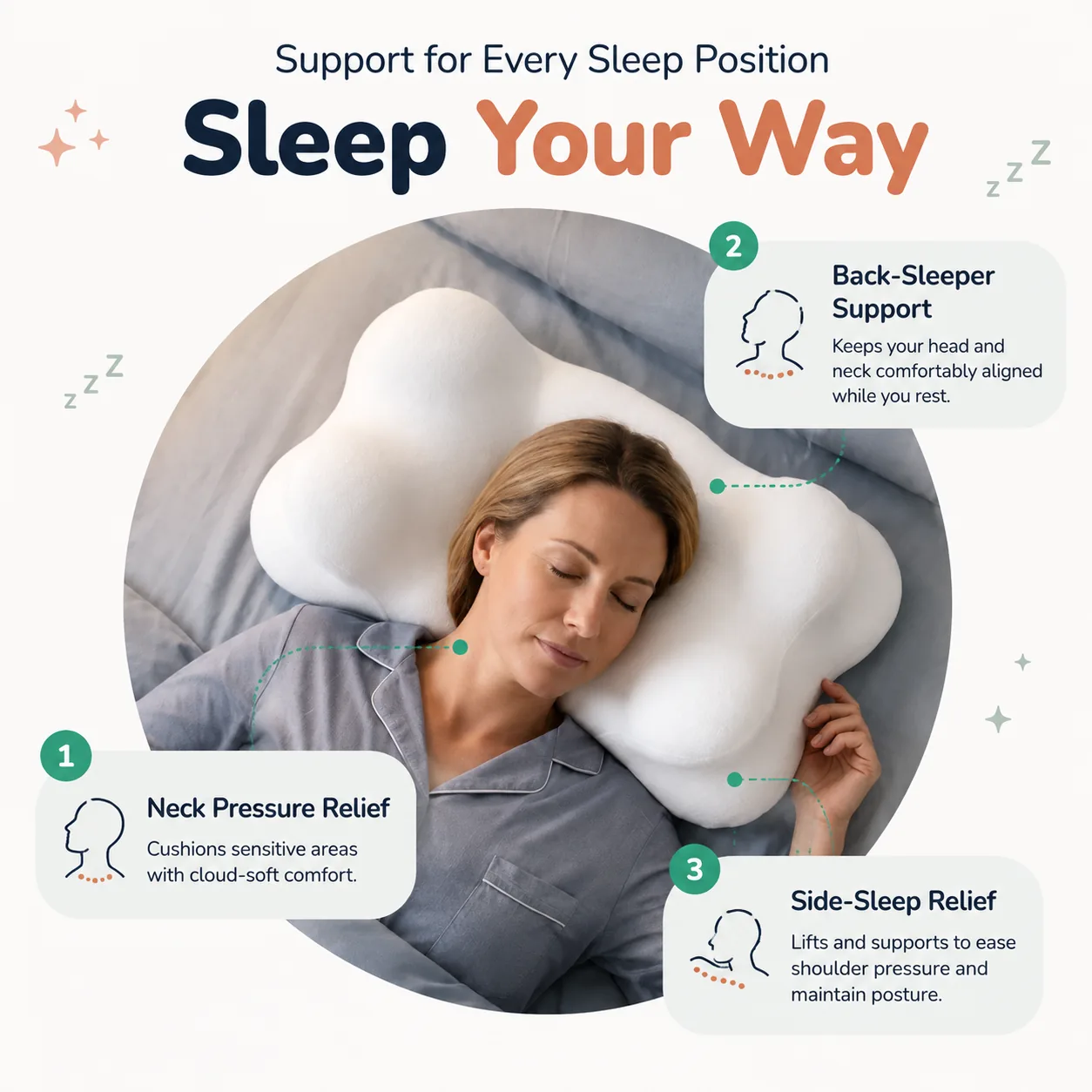

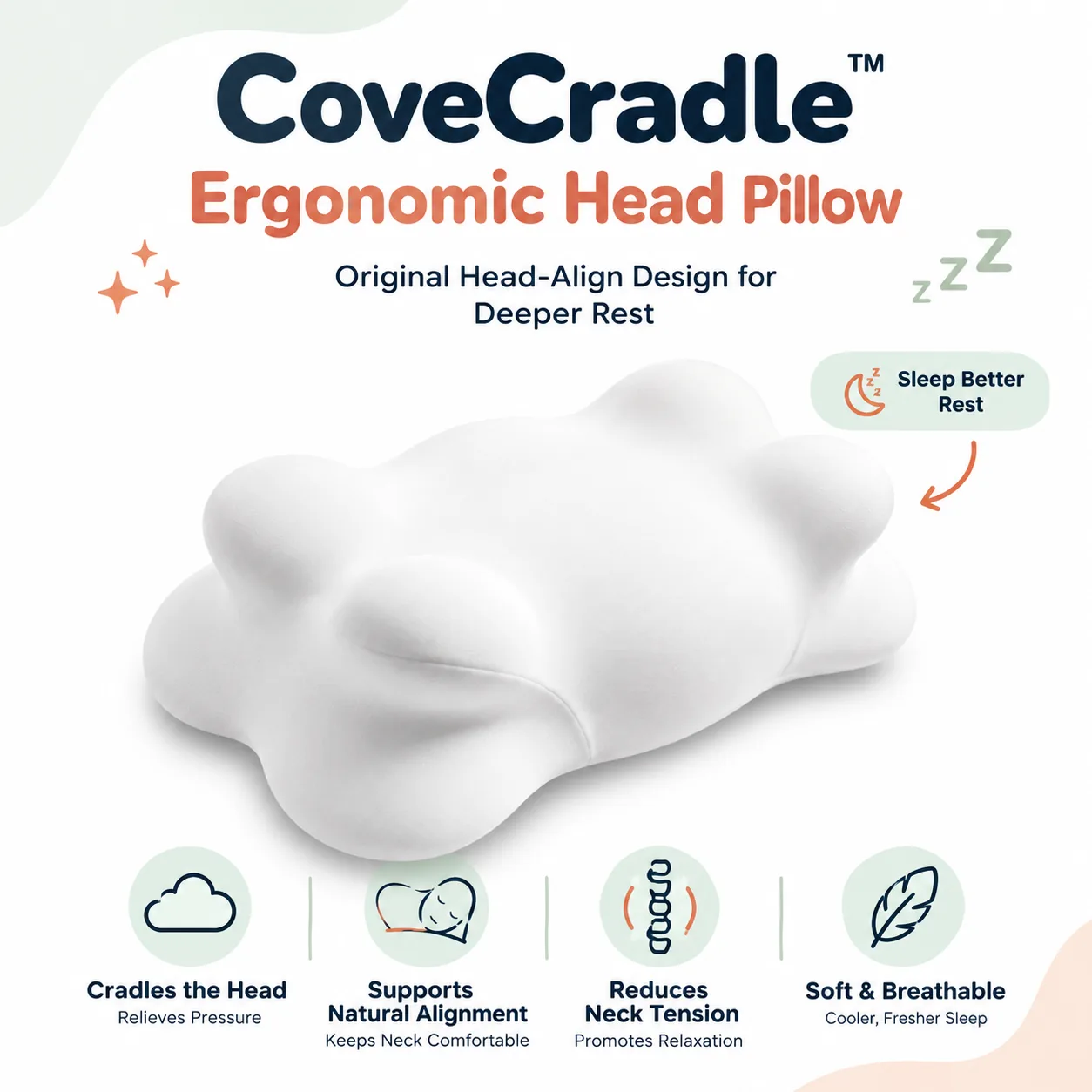
CoveCradle™
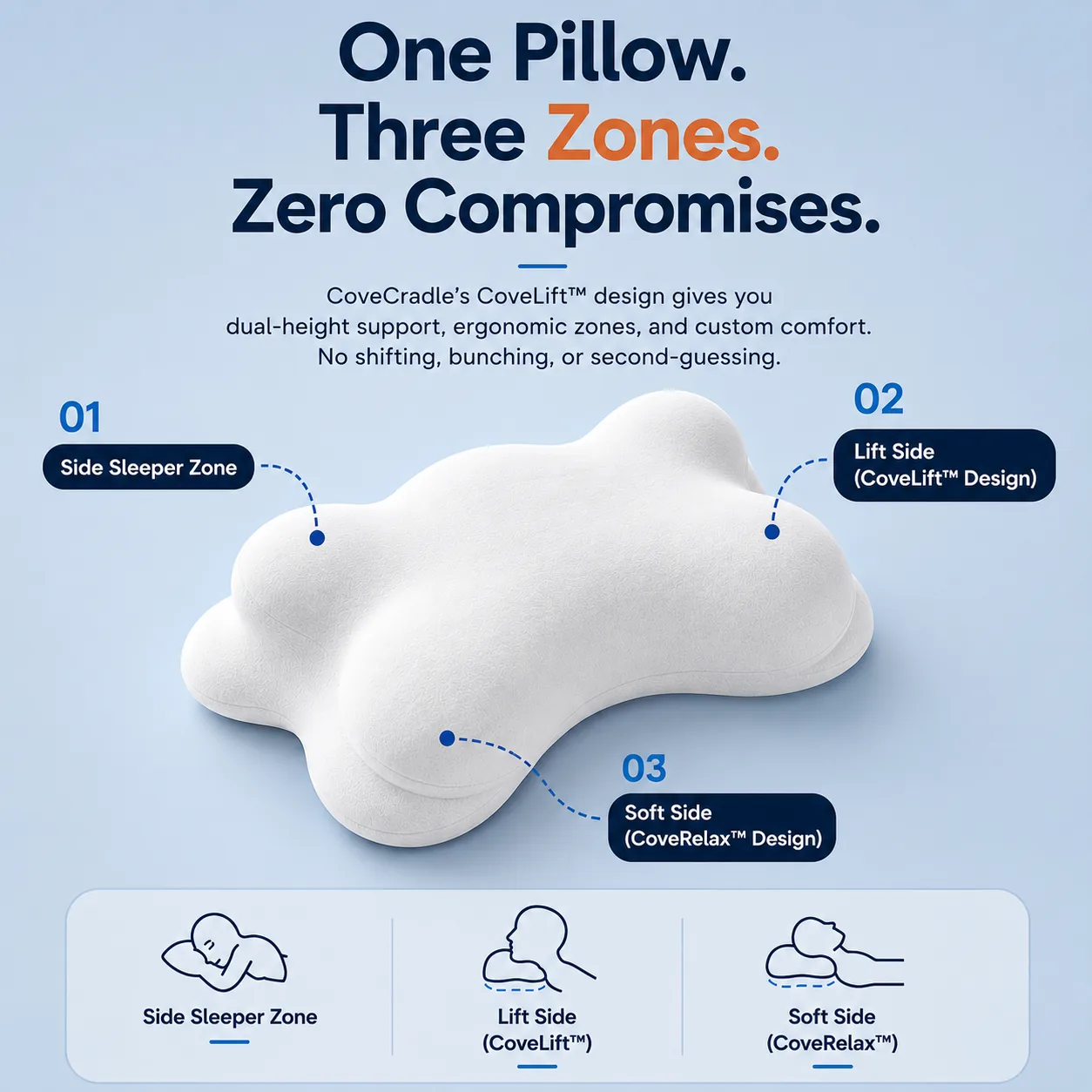
A channel cut for your shoulder and two heights to pick from — so your head sits level instead of bridging the gap all night.
You wake up stiff and blame your neck. But look at what your neck is doing down there: your shoulder is holding your head up off the mattress, and the pillow is meant to fill the rest. Too flat and your head sags. Too thick and it props. Either way your neck spends seven hours holding a bend — and you feel it before you're even upright.
✓A channel your shoulder drops into — the ShoulderWell™ cut-out gives the shoulder somewhere to go, instead of jamming it up under your ear
✓Two heights, one pillow — 12 cm edge for side sleeping, 9 cm for your back. Flip it instead of buying another one
✓It's the same height at 6am — memory foam that comes back, not fibre that packs down into a pancake by week three
Pillowcase Included: White
Every pillow ships with a zip-off white pillowcase. Take it off and wash it.
SLEEP SALE ENDS IN
02:59:59
In stock — estimated delivery —
Free shipping on this order
Ships from Australia
Secure checkout
30 nights. The test is the first ten minutes of the morning.
Not how it feels in the shop. How your neck feels when you sit up, turn your head to check the time, and reach for your phone. If that's still stiff after a month, send it back for a full refund.
Why a flat pillow makes your neck do the work
Lie on your side and measure the distance from your ear to the mattress. That gap is roughly the width of your shoulder — for most adults somewhere between 10 and 14 cm. A pillow's only real job is to fill it exactly.
- Fill it with too little and your head drops toward the mattress — the neck bends down and stays there
- Fill it with too much and your head is propped up — same bend, opposite direction
- Fold a flat pillow in half to get the height and you've built a wedge that collapses by 2am
- Honestly: if your stiffness comes from an injury or a disc, a pillow is not the answer. See a physio. This is for the neck that only hurts in the morning
What is the ShoulderWell™ Memory Core?
Most contour pillows shape the part under your head and stop there. The problem is a few centimetres lower — your shoulder gets compressed against the mattress and shoved up toward your ear, which is what pins the arm underneath you. ShoulderWell is a channel cut along the leading edge: the shoulder tucks into it rather than being squashed by it, so the head can sit level and the arm underneath keeps its room. The core is memory foam, so the shape you lie down on is the shape at 6am.
Which height should I pick?
You don't pick — you get both. One long edge sits at roughly 12 cm for side sleeping, the other at roughly 9 cm for your back. Flip it. Broad shoulders and strict side sleepers usually settle on the high edge; back sleepers and smaller frames on the low one.
What if I still wake up stiff?
30 nights. If the mornings haven't changed, we take it back and refund you. That's the deal.
The first ten minutes
You've started treating the morning as a warm-up.
Not an injury. Not anything a scan would find. Just a neck that starts every day locked and needs half an hour of ordinary movement to come back.
You reverse out of the driveway and your neck won't go that far, so you do the whole thing on mirrors. It's not dangerous yet. It's just one more thing your body has quietly stopped doing.
Memory foam. Bamboo. The expensive one from the bedding shop. The one your sister swore by. They're all in the linen cupboard, and none of them was the answer for longer than a fortnight.
You wake up, decide the pillow is too flat, fold it in half, and lie back down on a lump. By morning it's unfolded itself and you're back where you started.
You come to with one arm gone dead underneath you. You pick it up with the other hand and shake it until the pins and needles arrive. That's not sleep — that's your shoulder being crushed for hours.

The mechanism
Your neck isn't the problem. It's the thing holding the bend.
A neck that only hurts in the morning is usually not injured. It's held. Seven hours at a few degrees off straight will stiffen anything — and the reason it's off straight is almost always the few centimetres between your ear and the mattress.
Every pillow you've tried was trying to fill that gap with height alone. But height is only half of it. Your shoulder is sitting in the same space, getting compressed and pushed up toward your ear, which changes the gap it was supposed to fill. That's why the pillow that felt perfect in the shop stopped working in your own bed.
- A channel, not just a contour. The ShoulderWell™ cut-out gives the shoulder its own space along the leading edge, so it stops being pushed up under your ear — and the arm underneath stops being pinned.
- Two heights, because necks aren't one size. Roughly 12 cm on one edge, 9 cm on the other. If the first night is wrong, flip it — you're not sending it back and starting again.
- The same height at 6am. Memory foam recovers between nights. There's no fluffing, and no slow flattening into the pancake that sent you looking for a new pillow last time.
One pillow. Two heights. Flip it if you guessed wrong.
Most pillows make you commit at checkout and find out three weeks later. This one lets you find out on night two.
12 cm
The side-sleeper edge
For the shoulder-width gap. If you sleep on your side most of the night, if you're broad through the shoulders, or if you've always found pillows a bit flat — start here.
9 cm
The back-sleeper edge
For when there's no shoulder to clear. If you sleep on your back, if you're smaller-framed, or if every pillow feels like it's pushing your chin toward your chest — this is the one.
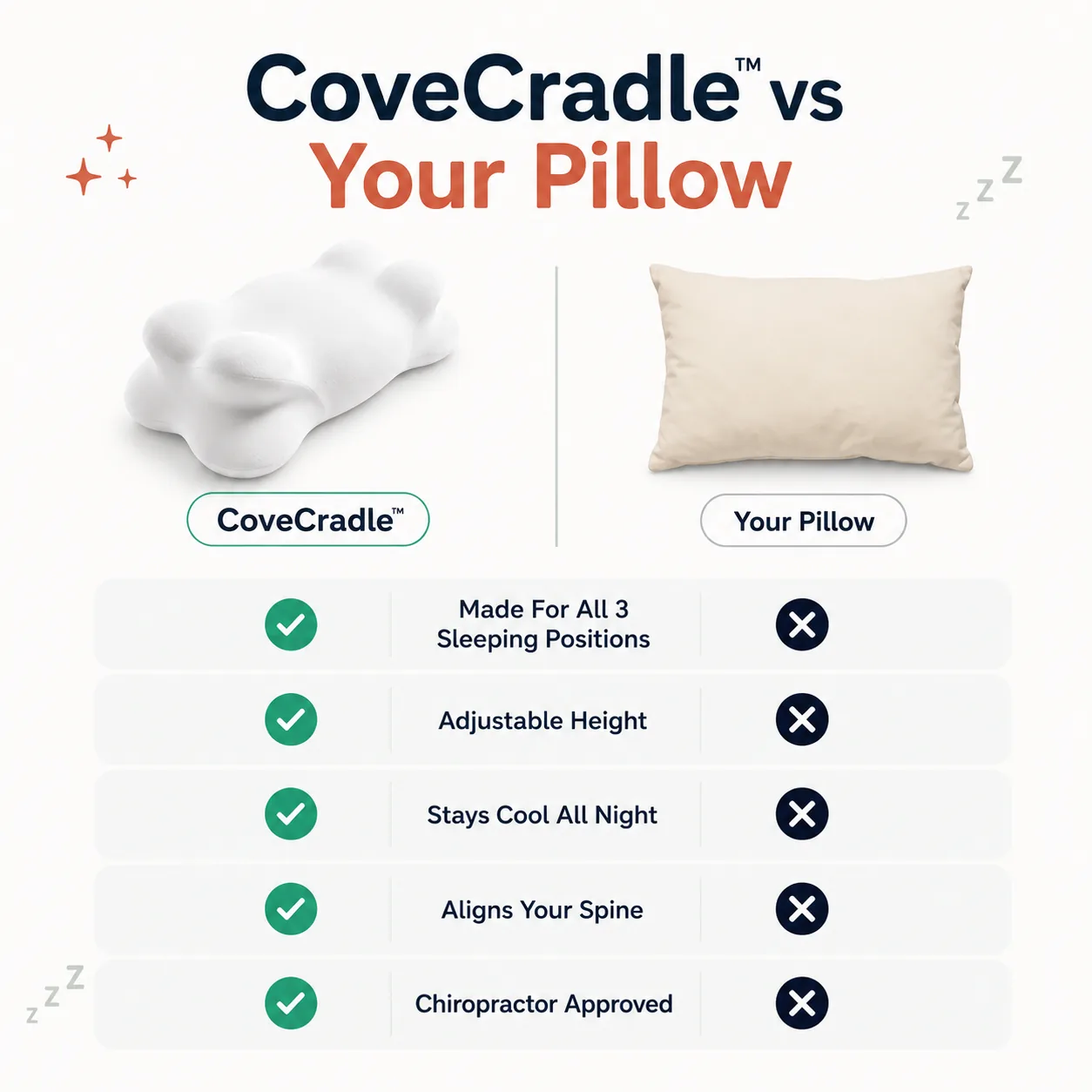
What's in the linen cupboard vs this
You weren't wrong to keep trying. You were buying height, and height on its own was never going to fix it.
Your last pillow
CoveCradle™
Room for your shoulder
Compressed flat
ShoulderWell channel
Wrong height on night one
Buy another
Flip it over
Same height in month three
Packed down
Memory core recovers
The 3am fold-in-half
Every night
Nothing to fold
If mornings aren't better
Linen cupboard
30 nights, full refund
What you'll notice
You won't notice the pillow. You'll notice the morning.
1
Night one
Start on the high edge if you sleep on your side. It will feel firmer than what you're used to — that's the gap actually being filled. Give it the full night before you judge it.
2
The first week
If you wake up with your chin tucked or your head propped, flip to the low edge. Most people land on the right side within three nights and stop thinking about it.
3
Somewhere in the first month
You reverse out of the driveway and check the blind spot over your shoulder without planning it first. That's the whole thing. That's what you bought.
What sleepers say
People who used to start every day with a warm-up.
★★★★★
I'd stopped checking my blind spot properly. Just mirrors and hope. Three weeks on this and I turned my head to reverse without thinking about it. I actually stopped the car.
Dean R.Newcastle · the reverse check★★★★★
Every morning started with twenty minutes of rolling my shoulders before I was any use. It's the first thing my wife noticed — I stopped doing the thing with my neck at breakfast.
Marcus T.Adelaide · the morning warm-up★★★★★
The dead arm was the worst part. Waking up and having to lift it with the other hand. The channel means my shoulder isn't jammed up anymore. Arm works when I wake up now.
Priya N.Melbourne · the dead arm★★★★☆
First two nights I thought I'd wasted my money — far too high. Then I read the card and flipped it. Completely different pillow. Would've returned it otherwise, so put that instruction on the front.
Helen B.Perth · flipped it★★★★★
Counted six pillows in the cupboard. Six. All of them fine for about a fortnight then flat as a envelope. This one is the same height it was in March.
Rob M.Brisbane · the pillow graveyard★★★★★
I'm a hairdresser, so I'm looking down all day and I assumed that was just the job. Turns out the job wasn't helping but the pillow was doing the real damage. Mornings are normal now.
Steph L.Gold Coast · looking down all day★★★★★
Used to fold my pillow in half at 3am to get the height, then wake up on a lump. There is nothing to fold. I hadn't realised how much of my night that was eating.
Anthony C.Wollongong · the 3am fold★★★★★
Broad shoulders and every pillow I've ever bought was too flat. This is the first one that actually fills the gap instead of letting my head sag toward the mattress.
Nadia F.Sydney · broad shoulders★★★★★
Back sleeper. Everything contoured I've tried shoves my chin into my chest. The low side doesn't. That's all I needed and nobody makes it easy to find.
Ian P.Hobart · chin to chest★★★★★
Physio kept telling me it was posture. Probably was, partly. But she also asked what I sleep on and pulled a face. Changed the pillow, and half the problem left on its own.
Janelle P.Cairns · the physio asked★★★★☆
Firmer than I expected and it took about a week to stop noticing it. Now I notice when I sleep anywhere else. Took it to my mum's at Easter, which tells you everything.
Chris L.Ballarat · took it travelling★★★★★
I'm 68. I'd decided the stiff neck was just age and there was nothing to be done about it. Apparently it was a pillow. Slightly annoyed about the years.
Anne M.Geelong · thought it was age30NIGHTS
30 nights. If you're still warming up in the mornings, we take it back.
Sleep on it for a month — both sides, properly. If you still sit up stiff, if your neck still won't turn far enough to reverse the car, send it back. Full refund. Long enough to know, and long enough that flipping it once doesn't cost you the trial.
Questions
I've bought four memory foam pillows already. Why is this different?
Because they were all solving the wrong half. A standard contour pillow shapes the bit under your head and leaves your shoulder to be squashed flat against the mattress — which changes the gap the pillow was meant to fill in the first place. The ShoulderWell channel gives the shoulder somewhere to go. That, plus two heights instead of one guess, is the whole difference. If your last pillow failed because it went flat, the memory core answers that too.
Will it help my neck pain?
Honest answer: it changes how your head and neck are supported while you sleep, which is often what's behind a neck that's only stiff in the morning. It is support, not treatment. If your pain is constant, radiates down an arm, followed an injury, or wakes you at night, see a physio or a GP — and be suspicious of any pillow sold as the fix for that.
How firm is it?
Firmer than the pillow you're replacing, almost certainly. That's usually the point — the sag is what was letting your head drop. Most people stop noticing it inside a week. If you don't, that's what the 30 nights are for.
I'm a stomach sleeper.
Then this is the wrong pillow, and we'd rather say so. Stomach sleeping wants the flattest thing you can find — both of these edges will be too high. Nothing here is built for you.
Does it sleep hot?
It's a memory foam core with a removable knit cover, which breathes better than a solid moulded block. If you run hot, the CoveCradle Cooling Pillowcase is the add-on to take.
Can I wash it?
A zip-off white pillowcase comes with it. Machine wash the case. The foam core doesn't go in the machine — spot clean it and let it air.
What if it doesn't help?
30 nights. If the mornings haven't changed, send it back and we refund you. Full stop.